

Tower Crash Game Rules & Features
What sets Tower Crash apart from other crash games — and what it means for how you play
Why Tower Crash Plays Differently
Most crash games give you one decision: when to cash out. Tower Crash by Astriona adds a second decision made before the round starts: which risk level to play at — LOW, MEDIUM, or HIGH. This choice directly controls the collapse probability curve for that round. It's not cosmetic — it fundamentally changes how the round unfolds.
Combined with the manual floor-stacking mechanic (you click BUILD to add each floor, not just watch a multiplier climb), this creates a game with two distinct strategic layers: pre-round setup and in-round timing. The RTP of 98% and the core cash-out mechanic are familiar from other crash games. The risk selector and active building mechanic on top are what make Tower Crash distinct.
The sections below cover the RNG mechanics first, then the risk selector in practical terms, then bet sizing guidance for Indian players.
How the RNG Determines Each Round
The collapse point is locked in before you place your bet
Tower Crash uses a provably fair system. Before each round opens for betting, the server generates a cryptographic hash of the seed that determines where the tower will collapse. You can see this hash before placing your bet — you just can't decode it until after the round.
Once the round ends, the server reveals the original seed. You can verify it matches the hash that was published before the round started. If the numbers match, the collapse point wasn't changed after you placed your bet. This is an open verification process, not a marketing claim.
- Server seed: generated pre-round, hashed and published before betting opens
- Client seed: your browser adds a random seed to the mix, so the casino can't predict your specific combination
- Result locked: collapse point is fully determined before anyone places a bet
- Post-round verification: server reveals original seed — you can verify it independently
Core Game Mechanics
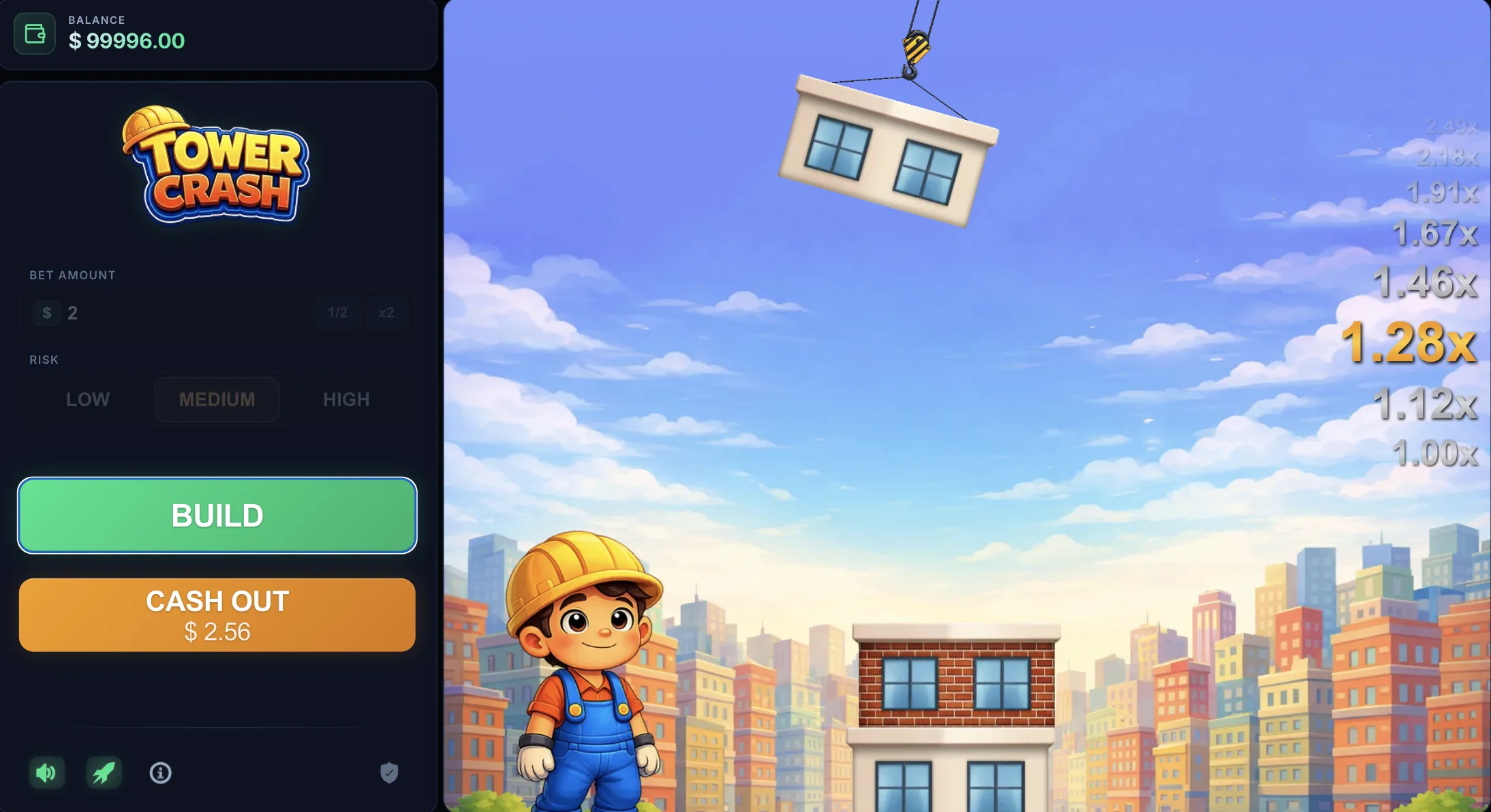
Each round of Tower Crash follows the same structure. You set your bet ($1 to $200), the round opens, and you start stacking floors. Every floor you add increases the multiplier applied to your bet. The tower can collapse at any floor — including the first one. You can cash out before collapse and keep whatever multiplier you've built. If collapse happens before you cash out, you lose the round's stake.
The collapse probability increases as the tower gets taller. A short tower (floors 1–5) has a lower collapse chance per floor than a tall one (floors 15+). This is the fundamental tension of the game: higher floors mean bigger multipliers but also higher collapse risk per additional click.
Unlike games where you watch a multiplier climb automatically, Tower Crash requires active participation — you choose when to add each floor, which means every click is a decision about risk.
Risk Selector — LOW, MEDIUM, HIGH
Set before the round — the single most important decision in Tower Crash
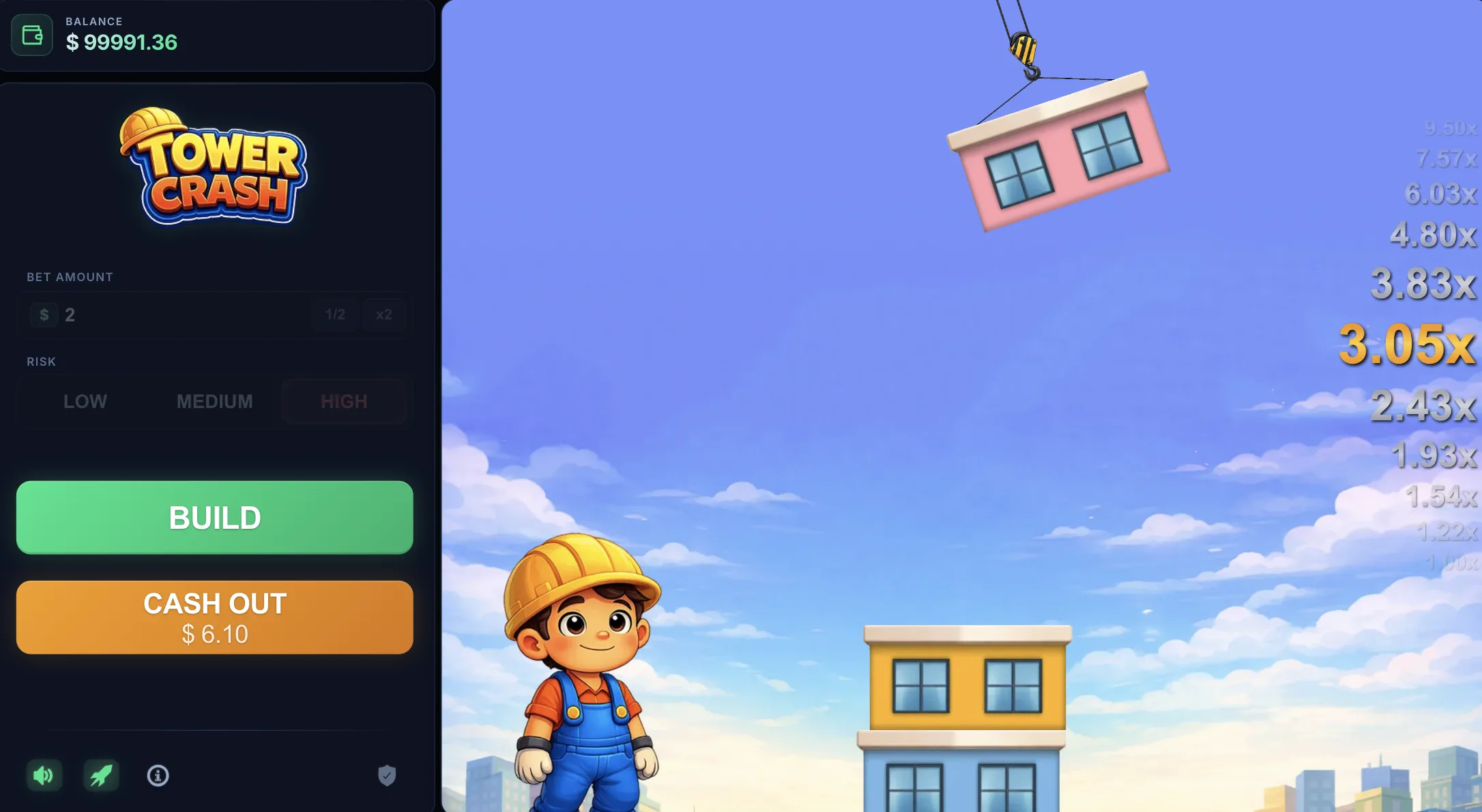
Before placing your bet, you choose a risk level. This is not a cosmetic setting — it directly controls the collapse probability curve for that round. LOW risk means the tower is less likely to collapse at any given floor height. HIGH risk means the tower is more likely to collapse early, but when it survives, the multiplier climbs faster.
Unlike other crash games where risk is implicit in the multiplier curve, Tower Crash makes it explicit and player-controlled. This is the primary strategic decision in the game — more important than when you cash out in most sessions.
- LOW risk: lower collapse probability per floor, slower multiplier growth. Suited to conservative play, tight bankrolls, learning sessions.
- MEDIUM risk: balanced probability/multiplier tradeoff. The default for most players in standard sessions.
- HIGH risk: steeper collapse probability, multiplier climbs faster. High variance — frequent early collapses offset by larger multipliers when the tower survives.

How the BUILD Button Works
Active participation — you choose when to add each floor
Unlike games where you watch a multiplier climb on its own, Tower Crash requires you to actively build the tower. Each tap of the BUILD button adds one floor and raises the multiplier. The round does not progress until you click — giving you full control over the pace.
This matters strategically: you can pause between floors to assess your position. There is no timer forcing you to act. The only pressure is internal — the knowledge that the tower could collapse at any click, and that holding too long will eventually cost you the stake.
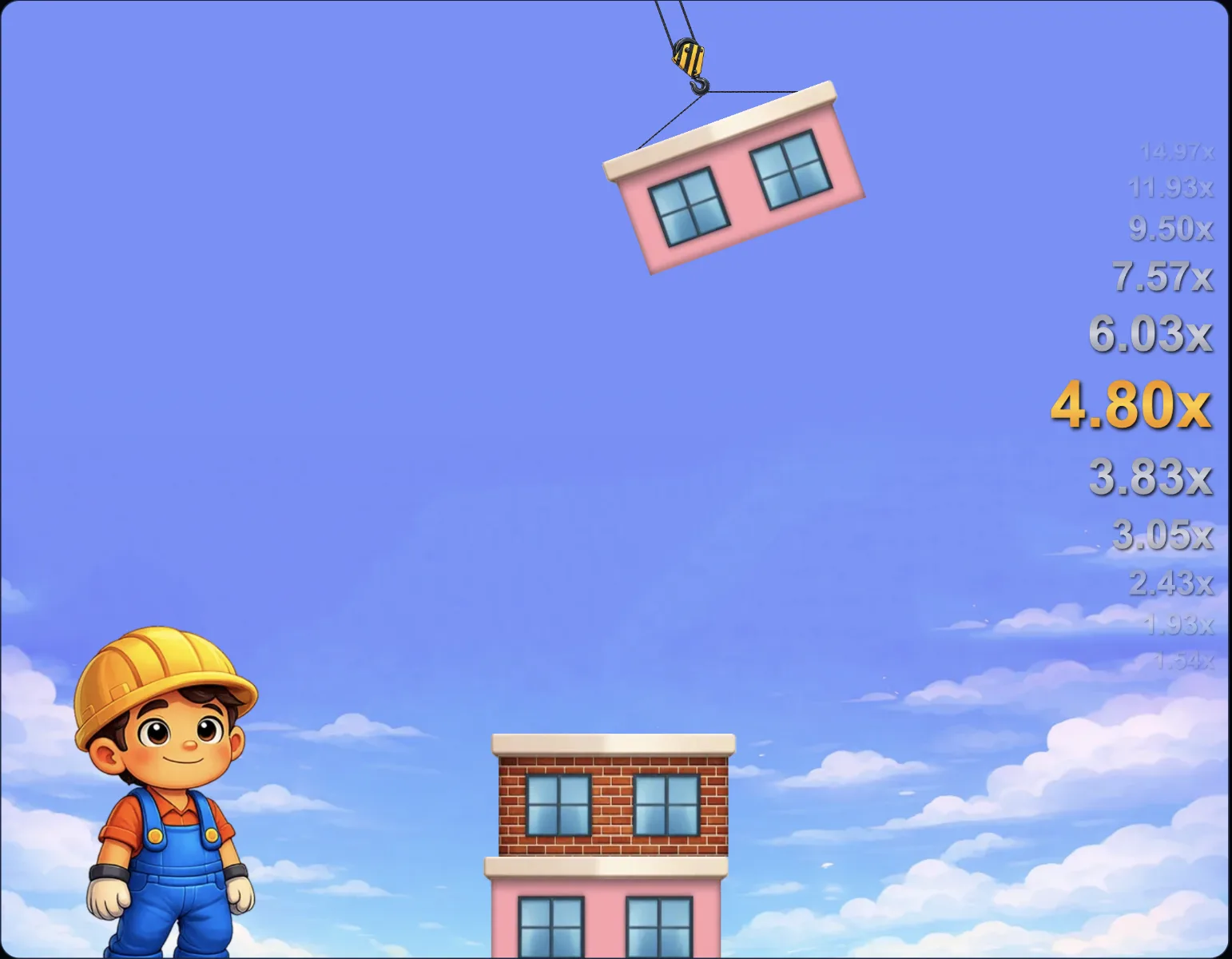
The multiplier shown on the right side of the screen is your current cash-out value. It updates with each floor added. The higher it climbs, the greater the potential return — and the higher the collapse probability for the next click.
Cash Out and Pending Bets
How the round ends — and what happens if you walk away
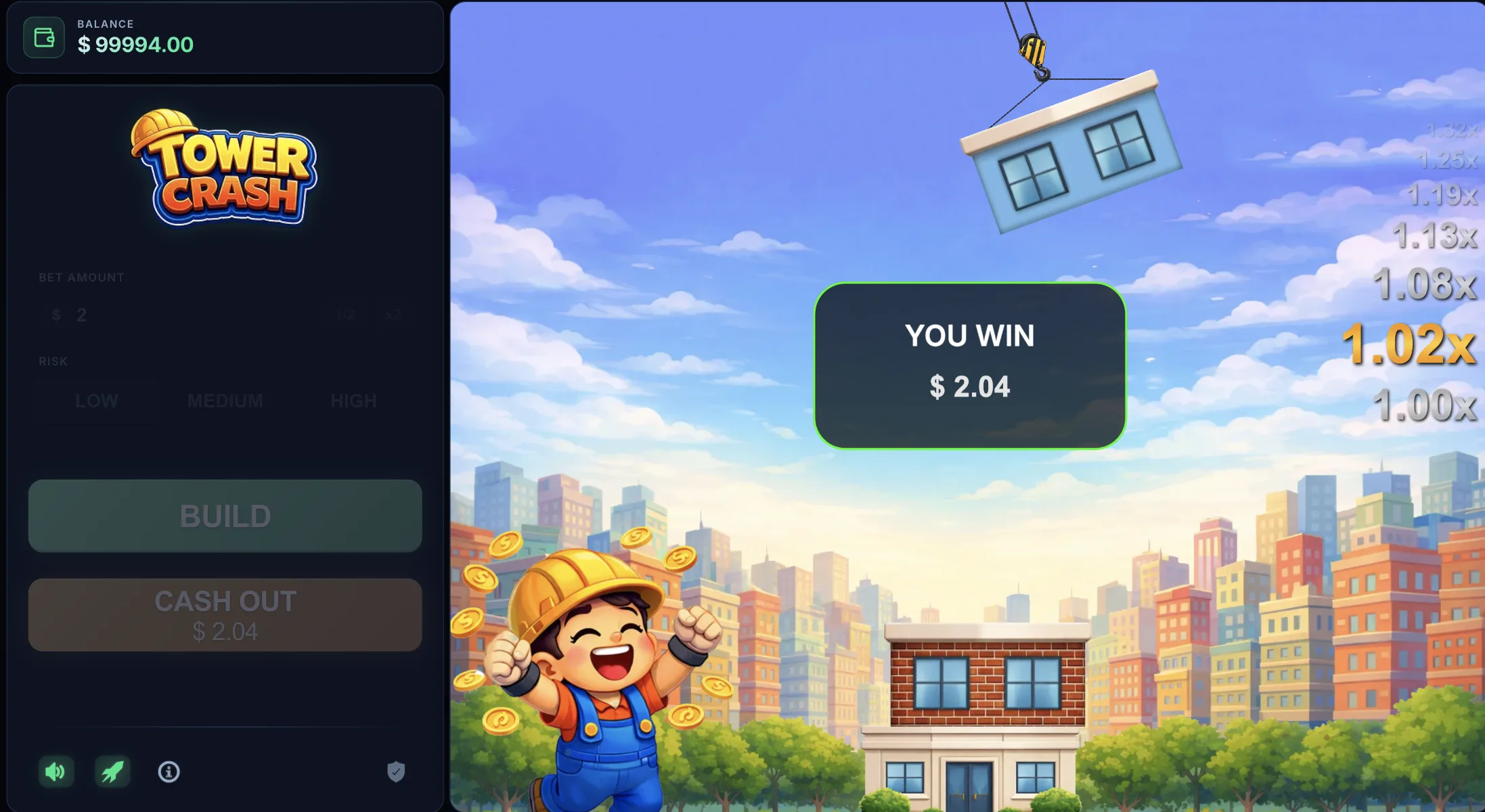
Clicking CASH OUT locks in your current multiplier and credits your winnings instantly. The amount shown on the CASH OUT button is what you receive — your original stake multiplied by the current floor multiplier.
If the tower collapses before you cash out, you lose the round's stake. There is no partial recovery — a collapse at floor 2 costs the same as a collapse at floor 20.
Pending bets: if you place a bet but do not interact with the game, the bet remains open. Pending bets are automatically closed after 12 hours or when you re-enter the game. This is relevant if you close your browser mid-round — the bet stays active on the server until one of these conditions is met.
- Cash out anytime during active building
- CASH OUT button shows current payout amount in real time
- Pending bets auto-close after 12 hours
- No partial payout on collapse — win all or lose stake
Risk Level Comparison
| Risk Level | Collapse Probability | Multiplier Growth | Variance | Best For |
|---|---|---|---|---|
| LOW | Lowest per floor | Gradual | Low | Conservative play, learning, tight bankroll |
| MEDIUM | Moderate | Balanced | Medium | Standard sessions, most players |
| HIGH | Highest per floor | Rapid | High | Chasing larger multipliers, accepting frequent early collapses |
Bet Sizing Guide for Indian Players
$1 to $200 per round — practical sizing by session bankroll
Tower Crash's native bet range is $1–$200 per round. At partner casinos accepting INR, you deposit in INR and the casino handles the conversion. The practical minimum entry at a ₹100 UPI deposit gives you 100+ rounds at minimum stake.
Set your per-round bet at 1–2% of your session bankroll. This gives you 50–100 rounds of runway before going to zero — enough to see variance even out and avoid going bust on a short losing streak.
| Session Bankroll (INR) | Recommended Bet | Estimated Rounds |
|---|---|---|
| ₹500 | $1 (minimum) | 50+ |
| ₹1,000 | $1–$2 | 100 |
| ₹5,000 | $5–$10 | 100 |
| ₹10,000 | $10–$20 | 100 |
| ₹50,000 | $50–$100 | 100 |
Ready to Try Tower Crash?
Try the risk selector in demo mode — available free at astriona.games or at partner casinos
FAQ: Tower Crash Rules & Features
What does the Risk Selector actually change?
The risk selector controls the collapse probability curve for that round. LOW risk means the tower is statistically less likely to collapse at any given floor height — the multiplier grows more slowly but you get more floors on average before collapse. HIGH risk raises collapse probability at each floor but lets the multiplier climb faster. MEDIUM is the balanced middle point. The setting is chosen before each round and cannot be changed once you start building.
Is the RTP 98% per round or over many rounds?
98% is a long-run statistical expectation across thousands of rounds, not a per-round guarantee. In a single session of 20–50 rounds, your actual result can vary significantly above or below that number. It's the average that emerges over large sample sizes — not what you should expect in one sitting.
What is the theoretical maximum payout?
No fixed maximum — the game rules list the maximum win as uncapped. At the $200 maximum stake, a deep tower run returning 100x would pay $20,000. The probability of extreme multipliers is very low; in practice most rounds resolve below 20x. The uncapped ceiling means very long runs are theoretically unlimited, but collapse probability rises with each floor added.
Can you change risk level mid-round?
No — the risk level is set before the round starts and cannot be changed while building. Once you place your bet and click BUILD, you are committed to the selected risk setting for that round. This is why choosing your risk level before each round is one of the two key pre-round decisions (the other being your cash-out target).
Is Tower Crash the same as Tower Rush?
No. Tower Rush is a separate game by Galaxsys. Tower Crash is by Astriona. They share the floor-stacking concept but are different games from different providers with different mechanics, RTPs, and risk systems. Tower Rush has bonus floors (Frozen Floor, Temple Floor, Triple Build) and an RTP of 96.5%. Tower Crash by Astriona has a risk selector (LOW/MEDIUM/HIGH), no bonus floors, and an RTP of 98%.
Is there a maximum win in Tower Crash?
The official game rules do not specify a fixed maximum win multiplier — the rules list Maximum Win as $0, which indicates no hard cap. In practice, very deep tower runs on HIGH risk are possible. Most sessions resolve well below extreme multipliers, as collapse probability increases with each floor added.
What happens if I place a bet and close my browser?
Your bet remains open on the server as a pending bet. Pending bets are automatically closed after 12 hours or when you re-enter the game — whichever comes first. If the round was still active, the outcome is resolved at that point. This means closing your browser does not automatically cancel a placed bet, so always cash out before navigating away.
Can the tower collapse on floor 1?
Yes. The RNG determines the collapse point before the round starts, and it can be set to any floor including the first. This is rare in practice — early collapses are less frequent than mid-round ones — but they do happen. This is why some players always set an auto-cashout target rather than relying on manual exits.