
Tower Crash Free Demo — A Training Tool, Not Just a Preview

The Tower Crash demo runs the same RNG and the same collapse distribution as real money play. The only difference is that your credits are virtual. Treating it as a five-minute preview means missing what it can actually tell you — collapse frequency at specific multiplier targets, how the three risk levels behave in practice, and how the game performs on your device before any money is on the line.
Used with a plan, 20 demo rounds can teach you more about Tower Crash than 20 real money rounds played without structure. This guide gives you that plan.
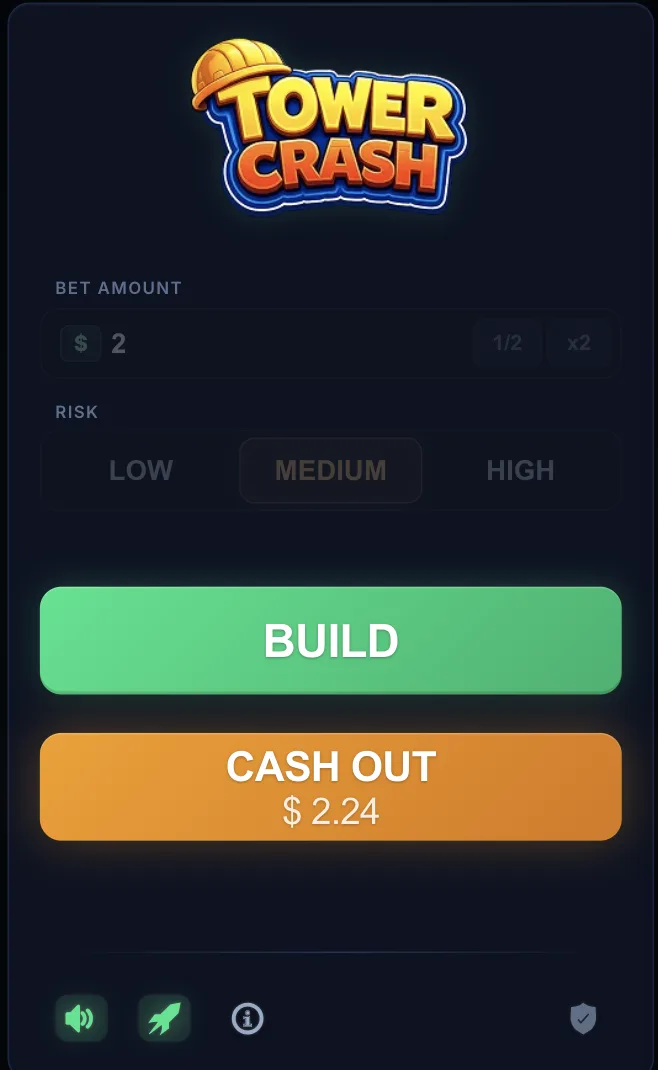
What You Can Actually Learn in 20 Demo Rounds
The demo gives you four pieces of real information that you cannot get from reading about the game.
How often does the tower collapse before 5x? Before 10x? Before 20x? The demo gives you actual data from the same RNG used in real money play. After 20 rounds, note how many ended before 3x, how many between 3x and 10x, and how many went beyond 10x. This tells you what a realistic session looks like — not what the max win stat implies.
LOW, MEDIUM, and HIGH each distribute collapse probability differently. In 20 rounds, run at least 5 rounds on each setting. You will directly observe how often early collapses occur on HIGH versus LOW, and what the typical multiplier range looks like per setting. This is information you cannot get from a description — you need to see the distribution in practice.
This is the most underrated thing the demo reveals. Watch when you actually click cash out. Do you bail out at 2x out of anxiety, or do you hold until 15x hoping for more? Your natural tendency — with no real money pressure — tells you which strategy you are actually suited to. Some people exit early every time; others hold well past reasonable targets. Either pattern is worth knowing before real money is involved.
Test how Tower Crash runs on your specific device and connection. Does it load quickly? Is the cash-out button responsive on mobile? Any lag between tap and registration can matter at high multipliers. Better to discover a performance issue in demo mode than during a real money round.
How to Launch the Tower Crash Demo — 3 Steps
A 20-Round Demo Session Plan
Four structured phases — each one teaches you something specific about how the game actually behaves.
On each of these rounds, do not press cash out. Keep building until the tower collapses. The point is to feel what a collapse actually looks like — how abrupt it is, what height it tends to occur at, and what the screen feedback is. These five rounds establish your baseline understanding of collapse mechanics. You will lose all five rounds intentionally.
No variation. Exit at exactly 2x on every single round regardless of bonuses, regardless of how strong the tower looks. This is the conservative strategy baseline. You will win most rounds. Record how often the tower was still building when you exited at 2x — this shows how often you left additional multiplier on the table.
Set 5x as your target for each round. Hold until you reach it or collapse — no early exits. Note how many of the five rounds reach 5x. This gives you real data on the hit rate at a moderate multiplier target. Compare it to your 2x hit rate from rounds 6–10.
Switch to HIGH risk and set an 8x target. Accept that some rounds will collapse very early — that is expected on HIGH. When a round does run long, hold to your 8x target. After these five rounds you will have experienced the HIGH risk distribution firsthand and will know whether the volatility suits how you want to play with real money.
- Approximate collapse distribution across a realistic sample
- Your actual hit rate at 2x versus 5x
- How the three risk levels (LOW/MEDIUM/HIGH) behave differently in practice
- Which of the three strategy styles matches how you naturally play
Demo vs Real Money — One Key Difference
The RNG is identical. Risk levels behave at the same distributions. Collapse mechanics are the same. Everything technical is the same in demo mode.
The one real difference is psychological: bet pressure. When virtual credits disappear in demo mode, you feel nothing. When real money disappears, you feel it — and that feeling changes your decision-making. Players who have only used the demo sometimes discover their real money behavior is completely different: they cash out far too early out of anxiety, or they hold too long trying to recover a loss.
Knowing this in advance lets you prepare. Before you deposit, decide on your strategy and your cash-out target. Write it down if necessary. The demo teaches you the mechanics. Your strategy plan handles the psychology gap when real money is involved.
The players who use demo mode most effectively are the ones who treat it as a rehearsal — not just for the game mechanics, but for their own decision-making under the specific conditions they plan to play under.
When You're Ready for Real Money — Checklist
Before switching from demo to real money, verify all four of these.
- You have played at least 5 rounds on each risk level. LOW, MEDIUM, and HIGH each produce a different collapse pattern. If you have only played on one setting, you do not know how the game actually behaves across the range you will use with real money.
- You know which risk level you will start on. Most new players should start on LOW. If you are choosing MEDIUM or HIGH, make sure you have seen enough rounds on that setting to understand the early-collapse frequency and are prepared for it psychologically.
- You have a cash-out target you will commit to. A target you chose in advance, written down, that you will not deviate from mid-round. If you do not have a number before the round starts, you are not ready.
- You know your session budget. What is your total budget for the session? What is your stake per round (1–2% of that budget)? What is your stop-loss (50% of session budget)? If you cannot answer all three of these questions, do more planning before depositing.
Try the Demo Now
Access Tower Crash demo at any partner casino — no account required at most.
When you're ready to play for real, use promo code towercrash2026 for your welcome bonus.
Frequently Asked Questions
Yes, in all technical respects. The demo runs the same RNG, the same risk level distributions, and the same collapse mechanics. The only difference is that you are using virtual credits rather than real money. Multipliers and round outcomes are generated identically to real money play.
At most partner casinos, no. You can access Tower Crash demo mode without creating an account by selecting "Play for Fun" or "Demo" from the game page. At a small number of casinos, a free account registration is required before demo access. Check the individual casino pages for their specific policy — 1Win and PIN-UP both allow no-registration demo play.
No. Demo mode uses virtual credits only. Any winnings or losses are virtual and cannot be withdrawn. To win real money you need to be playing with a real money balance at a registered casino account. If you want to transition from demo to real money, see the registration guide.
There is no time limit on Tower Crash demo mode. Virtual credits are typically provided in large amounts (equivalent to ₹5,000–₹10,000+) and replenish automatically if they run out at most casinos. You can run as many rounds as you need — including the full 20-round structured session plan outlined above.
Yes. Tower Crash is a browser-based game and the demo works on mobile devices the same as on desktop. No app download is required. Access via your mobile browser at any partner casino and select demo mode. This is also a good opportunity to test the cash-out button responsiveness on your specific device before playing for real money.
PIN-UP and 1Win both offer the demo without registration and have the most stable platform performance in our testing. Fresh Casino also has a clean demo experience with minimal load time. For the structured 20-round plan, PIN-UP is our recommendation because of its no-registration access and stable performance across devices. See the full casino comparison for details.